Briefing
Penetration testing selection criteria for the people who sign
Penetration testing selection criteria are the written tests leadership applies before choosing a provider. Agreed in advance, they make the decision fair, quick and easy to explain later.
- Principal-led mandates
- Fixed fee agreed in writing
- Nothing retained afterwards
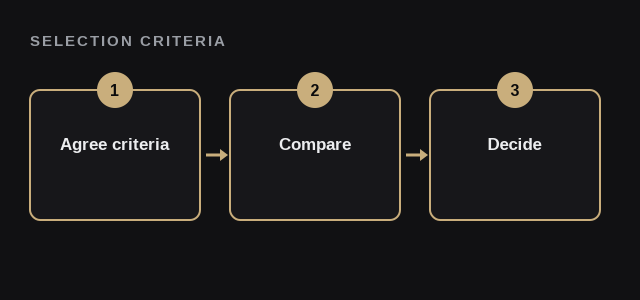
Why written penetration testing selection criteria help
Without criteria, the choice drifts toward the best presentation or the lowest number. Neither tells you much about the work itself.
With criteria agreed first, each provider answers the same questions. Therefore the comparison holds up when someone asks why one was chosen.
Core penetration testing selection criteria
Most criteria fall into five groups. Weight them to suit your situation, and write the weights down before any proposal arrives.
Then score each provider against the same list. As a result, the decision is visible on one page.
| Criterion | What to ask for |
|---|---|
| Who does the work | The named person who leads and reports |
| Method | A named public standard and its phases |
| Data handling | What is kept, and when it is destroyed |
| Fees | One fixed number per scope |
| References | A reference client, under NDA |
Selection scorecard
Tick each answer you have in writing from a provider.
Your result appears here as you tick, so you can see what is still open.
Who does the work
Ask who will be on your systems, by name. Also ask whether any part is subcontracted.
This criterion often decides the rest. Because the person who tests also writes the findings, their experience shapes the whole report.
Applying penetration testing selection criteria to data
Testing produces sensitive evidence about your weaknesses. So ask how it moves, where it is stored and when it is destroyed.
A clear answer is short. For example, encrypted channels while the work is live, and destruction when the engagement closes.
References and discretion
Many serious providers publish no client names. Instead, they offer a reference conversation in writing, once a non-disclosure agreement is signed.
That is normal, and it is a fair test in itself. A provider that names clients freely may name yours too.
How Sentinel Black answers them
A senior professional hacker leads each mandate personally, with no junior bench and no subcontracting. Nothing is retained afterwards, and references are introduced in writing under a signed NDA.
Full mandates run from $35,000 to $120,000, while the floor is $25,000. Also, the bounded Exposure Assessment starts at $4,500. Moreover, its fee is credited in full against a full engagement commissioned within ninety days. One fixed fee is agreed after the written scoping brief, and it is invoiced against milestones. The method follows the Penetration Testing Execution Standard and the OWASP Web Security Testing Guide.
Penetration testing selection criteria questions
Who should agree the penetration testing selection criteria?
The program owner, with procurement and the system owners.
Should price lead the penetration testing selection criteria?
Price matters. However, who does the work usually matters more.
How many providers should we compare?
Two or three is usually enough.
Can penetration testing selection criteria change later?
Only before proposals arrive, so the comparison stays fair.
Related guides
Request an introduction
Send your criteria with a short description of the scope. A senior professional hacker replies within one business day when the mandate is a fit.
Request an introduction