Briefing
Penetration testing after a breach: checking that recovery worked
Penetration testing after a breach is an authorized test commissioned once an incident is contained. It answers one question for leadership: is the recovered estate now as safe as we believe?
- Principal-led mandates
- Fixed fee agreed in writing
- Nothing retained afterwards
Why penetration testing after a breach matters
After an incident, teams fix the route that was used. However, leadership also needs to know whether other routes remain open.
A test gives an independent answer. Therefore it supports the decision to declare recovery complete.
When to commission penetration testing after a breach
Timing matters. Testing too early can confuse the incident work, while testing too late leaves doubt open for months.
So agree the timing with whoever leads the incident response. As a rule, testing starts once the incident is contained and the main fixes are in place.
| Stage | Testing role |
|---|---|
| Incident active | No test; response comes first |
| Contained | Plan the scope and authorization |
| Main fixes applied | Test the recovered estate |
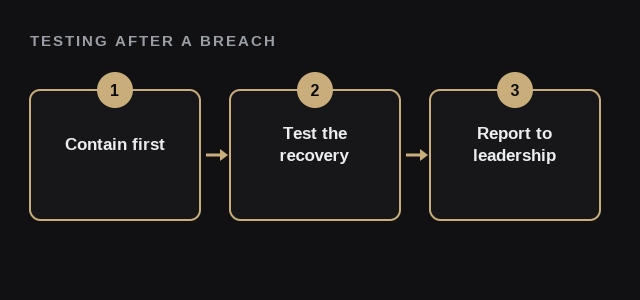
| Recovery declared | Retest and report to leadership |
Post-incident testing checklist
Tick each item before testing starts.
Your result appears here as you tick, so you can see what is still open.
What a test after an incident is not
It is not incident response, and it is not an investigation. Those are separate pieces of work with their own specialists.
Nor is it an attempt to identify or retaliate against whoever attacked you. That belongs with law enforcement.
Scoping penetration testing after a breach
Start with the systems involved in the incident, then add those connected to them. Also include anything rebuilt during recovery, because new builds can carry new gaps.
As always, the system owner signs the authorization first. In addition, counsel may want to review the scope while the incident is still open.
Reporting to leadership
The report should answer the original question in plain terms. Is the recovered estate safe, and what is still open?
Then track the remaining items like any other findings. As a result, the board sees the incident closed with evidence, not assumption.
How we handle these mandates
A senior professional hacker leads the mandate personally, and the engagement letter is signed before any technical discussion. Evidence moves only over encrypted channels and is destroyed when the engagement closes.
Full mandates run from $35,000 to $120,000, while the floor is $25,000. Also, the bounded Exposure Assessment starts at $4,500. Moreover, its fee is credited in full against a full engagement commissioned within ninety days. One fixed fee is agreed after the written scoping brief, and it is invoiced against milestones. The method follows the NIST SP 800-115.
Penetration testing after a breach questions
When should penetration testing after a breach start?
Once the incident is contained and the main fixes are in place.
Is penetration testing after a breach the same as incident response?
No. It is a separate, authorized test of the recovered estate.
Will penetration testing after a breach identify the attacker?
No. That belongs with law enforcement.
Who should see the report?
Leadership, the incident lead and the system owners.
Related guides
Request an introduction
Tell us when the incident was contained and which systems were involved. A senior professional hacker replies within one business day when the mandate is a fit.
Request an introduction