Briefing
Penetration testing for executives: what to know before you sign
Penetration testing for executives comes down to a few questions. What is being tested, what will it prove, what are we signing, and what do we do with the answer? This briefing covers each one plainly.
- Principal-led mandates
- Fixed fee agreed in writing
- Nothing retained afterwards
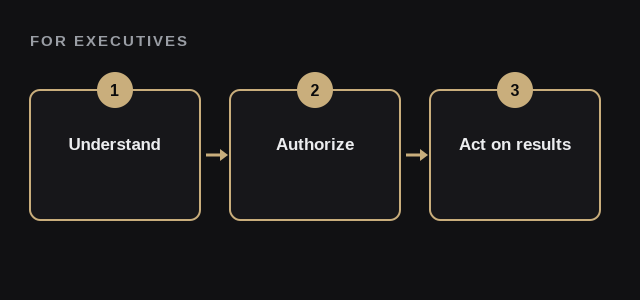
What penetration testing for executives should explain
A penetration test is an authorized attempt to reach something valuable, using the methods a real intruder would. It ends with the route, the evidence and the remedy.
So it answers a business question: could someone reach what matters most? A scan lists issues, while a test shows what they add up to.
What executives are asked to sign
Penetration testing for executives usually asks for two things. First, approval of the budget and scope. Second, where you own the systems, written authorization for the test itself.
Read the scope before you sign. Because it defines what is in and out of bounds, it is the most important page in the file.
| Document | Why it matters to you |
|---|---|
| Scope | Defines what may be tested |
| Authorization | Makes the test lawful |
| Non-disclosure | Protects what is found |
| Fee | One fixed number, agreed first |
Penetration testing for executives sign-off list
Tick each item before you approve a test.
Your result appears here as you tick, so you can see what is still open.
Reading the results
Good penetration testing for executives ends with a short summary in business terms, then detailed findings for your teams. Focus on the summary and the few most serious findings.
Then ask three questions. What could someone reach, how quickly will it be fixed, and who owns each fix?
Penetration testing for executives and personal exposure
Senior leaders are sometimes targets in their own right. Where that is a concern, testing can include an executive's own footprint, but only with that person's written consent.
That work is handled as a separate, private mandate. Therefore it never mixes with the organization's main report.
Common mistakes in penetration testing for executives
One mistake is treating a clean report as proof of safety. A test covers a scope and a moment, nothing more.
Another is approving a test and never asking about the fixes. As a result, the same findings return next year.
What working with us looks like
A senior professional hacker leads every mandate personally and writes the debrief. The engagement letter is signed before any technical discussion, and nothing is retained afterwards.
Full mandates run from $35,000 to $120,000, while the floor is $25,000. Also, the bounded Exposure Assessment starts at $4,500. Moreover, its fee is credited in full against a full engagement commissioned within ninety days. One fixed fee is agreed after the written scoping brief, and it is invoiced against milestones.
Penetration testing for executives questions
What does penetration testing for executives cover?
What a test proves, what leaders sign and how to read the results.
Does penetration testing for executives need their signature?
Where they own the systems, yes. Otherwise the system owner signs.
Can penetration testing for executives include personal exposure?
Yes, with the executive's written consent, as a separate private mandate.
Is a clean report proof of safety?
No. It covers a scope and a moment only.
Related guides
Request an introduction
Tell us what you need protected and what you are trying to prevent. A senior professional hacker replies within one business day when the mandate is a fit.
Request an introduction