Briefing
Writing a penetration testing business case leadership can approve
A penetration testing business case is the short document that asks leadership to fund testing. It works when it ties the test to a business decision, rather than to fear or a vague sense of best practice.
- Principal-led mandates
- Fixed fee agreed in writing
- Nothing retained afterwards
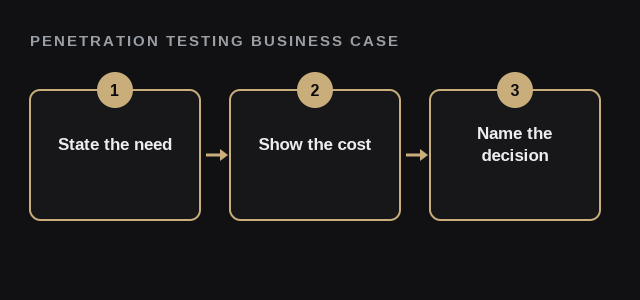
Why a penetration testing business case is needed
Testing competes with every other request for budget. So approvers need to see what they get, what it costs and what happens if they say no.
A clear case also helps afterwards. Because it states what the test should answer, the results can be checked against it.
What a penetration testing business case contains
Keep it to one or two pages. Approvers read short cases, and long ones are usually skimmed.
Then end with a single request. As a result, the decision is easy to make and easy to record.
| Section | What it says |
|---|---|
| The need | A customer, contract, launch or board question |
| The scope | Which systems, and why those |
| The output | What the report will show |
| The cost | One fixed fee, plus internal time |
| The decision | What leadership is asked to approve |
Business case checklist
Tick each section your draft already has.
Your result appears here as you tick, so you can see what is still open.
Common drivers for a penetration testing business case
Most cases rest on a concrete trigger. For example, an enterprise customer asks for evidence of testing before signing, or a launch date is fixed.
Name the trigger plainly, with its date. Therefore approvers see that the need is real and the timing is not arbitrary.
Showing the cost honestly
Include the provider fee and the time your own engineers will spend on preparation and fixes. Leaving the second out makes the case look smaller than it is.
Also show any option to start small. A bounded review can answer one question first, before a full mandate is approved.
What not to claim
Avoid promising that a test will prevent a breach. It shows what could be reached in one scope at one moment, and that is valuable enough.
In addition, avoid inflated loss figures. Approvers discount them, and the case loses credibility.
Figures you can quote from us
Full mandates run from $35,000 to $120,000, while the floor is $25,000. Also, the bounded Exposure Assessment starts at $4,500. Moreover, its fee is credited in full against a full engagement commissioned within ninety days. One fixed fee is agreed after the written scoping brief, and it is invoiced against milestones.
A senior professional hacker leads every mandate personally, and nothing is retained afterwards, so your case can state who does the work and how evidence is handled.
Penetration testing business case questions
How long should a penetration testing business case be?
One or two pages, ending with one request.
What is the strongest penetration testing business case?
A concrete trigger with a date, such as a customer request.
Should a penetration testing business case include internal cost?
Yes. Engineering time for preparation and fixes is real cost.
Can we start smaller?
Yes. A bounded review can answer one question first.
Related guides
Request an introduction
Send the trigger and the scope you have in mind. A senior professional hacker replies within one business day with a fixed number you can put in the case.
Request an introduction