Briefing
Risk based penetration testing: testing what would hurt most, first
Risk based penetration testing ranks systems by what a breach would cost the business. Then it tests them in that order. So limited time and budget go where the answer matters most.
- Principal-led mandates
- Fixed fee agreed in writing
- Nothing retained afterwards
Why risk based penetration testing makes sense
No organization can test everything deeply every year. Therefore the real question is not whether to choose, but how.
Ranking by business impact gives a defensible answer. For example, a system holding customer records usually comes before an internal wiki.
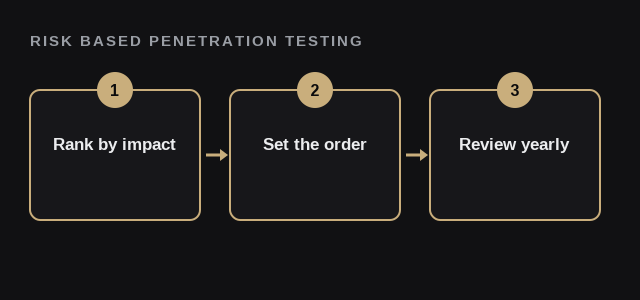
Ranking systems for risk based penetration testing
Leadership owns the ranking, because it reflects business impact rather than technical detail. Security then turns it into a calendar.
Keep the scale simple. Three or four levels are enough, and each system gets one.
| Question | Why it matters |
|---|---|
| What data does it hold? | Sensitive data raises impact |
| Does revenue depend on it? | Downtime has a direct cost |
| Do customers or partners rely on it? | Trust and contracts are at stake |
| When was it last tested? | Older results carry less weight |
| Has it changed recently? | Change brings new risk |
Risk ranking checklist
Tick each step your organization has completed.
Your result appears here as you tick, so you can see what is still open.
Turning the ranking into a plan
Test the top tier first and most deeply. Then cover the next tier across the year, and the rest on a longer cycle.
In addition, write the order into the program. As a result, a later reviewer can see why each system was tested when it was.
Risk based penetration testing and depth
Ranking also sets depth. A top-tier system may deserve a full mandate, while a lower tier may only need a bounded review.
However, do not thin the top tier to fit more systems in. Because depth is what finds the serious issues, it should be protected.
Reviewing the order
Rankings go stale. So review them each year, and after any acquisition, major launch or serious incident.
Also check the results against the ranking. If a lower-tier system produced a serious finding, its tier may be wrong.
How a mandate fits the ranking
A senior professional hacker scopes each mandate personally, so the depth matches the tier you set. Where a budget will not carry a scope, we change the scope rather than the standard, and the bounded Exposure Assessment covers the outer edge.
Full mandates run from $35,000 to $120,000, while the floor is $25,000. Also, the bounded Exposure Assessment starts at $4,500. Moreover, its fee is credited in full against a full engagement commissioned within ninety days. One fixed fee is agreed after the written scoping brief, and it is invoiced against milestones.
Risk based penetration testing questions
Who decides the order in risk based penetration testing?
Leadership ranks impact. Security turns it into a calendar.
Does risk based penetration testing skip low-tier systems?
No. They are tested less often or less deeply.
How often is the ranking reviewed?
Yearly, and after any major change.
Is risk based penetration testing accepted by auditors?
Usually, when the ranking and its reasons are written down.
Related guides
Request an introduction
Send your top-tier systems and what you are trying to prevent. A senior professional hacker replies within one business day when the mandate is a fit.
Request an introduction