Briefing
The penetration testing program: from single tests to a planned cycle
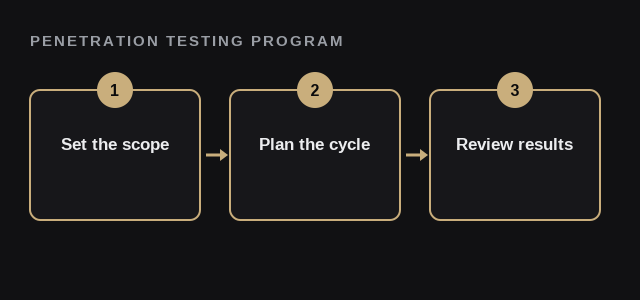
A penetration testing program is a planned cycle of tests with owners, a calendar and a budget. It replaces one-off purchases. So leadership can see what is tested, when, and what changed as a result.
- Principal-led mandates
- Fixed fee agreed in writing
- Nothing retained afterwards
Why a penetration testing program beats one-off tests
Single tests answer single questions. However, they rarely show whether the organization is improving, because each one is scoped and read in isolation.
A program links them. Therefore each test builds on the last, and the board sees a trend rather than a list.
What a penetration testing program contains
Keep the founding document short. It should fit on a few pages, so the people who approve it actually read it.
Then review it once a year. As a result, the program moves with the business rather than lagging behind it.
| Element | What leadership decides |
|---|---|
| Scope | Which systems are in the cycle |
| Calendar | When each area is tested |
| Owners | Who commissions and who fixes |
| Budget | The annual figure and its split |
| Reporting | What the board sees and how often |
| Exceptions | Who can accept a risk in writing |
Program readiness list
Tick each element your organization already has in writing.
Your result appears here as you tick, so you can see what is still open.
Ownership of the penetration testing program
One senior owner should hold the program, usually the CISO or the head of security. In addition, each system in scope needs an owner who signs its authorization.
Because the signature is the legal basis for testing, that role cannot be delegated loosely. So name the signatories in the program itself.
Planning the calendar
Start with what matters most to the business. Then spread the rest across the year, so engineering teams are not hit by every test at once.
Also leave room for change. For example, a major launch or an acquisition may need a test that the calendar did not foresee.
Reviewing a penetration testing program
Each year, compare the plan with what happened. Were tests run on time, were findings fixed, and did the same issues return?
Those three answers tell leadership whether the program works. Therefore put them at the top of the annual review.
How a mandate fits your program
A senior professional hacker leads each mandate personally, from scoping to the debrief, and nothing is subcontracted. Evidence and findings are destroyed when the engagement closes, so your program keeps the only copy.
Full mandates run from $35,000 to $120,000, while the floor is $25,000. Also, the bounded Exposure Assessment starts at $4,500. Moreover, its fee is credited in full against a full engagement commissioned within ninety days. One fixed fee is agreed after the written scoping brief, and it is invoiced against milestones. The method follows the Penetration Testing Execution Standard.
Penetration testing program questions
Who should own a penetration testing program?
Usually the CISO or head of security, with named system owners beneath.
How often is a penetration testing program reviewed?
Once a year, and after any major change to the business.
Does a penetration testing program need one provider?
No. However, continuity of method makes results easier to compare.
What does the board see?
A short summary of tests run, findings fixed and risks accepted.
Related guides
Request an introduction
Describe the program you are building and the first area to test. A senior professional hacker replies within one business day when the mandate is a fit.
Request an introduction