Briefing
Penetration testing governance: who decides, who signs, who oversees
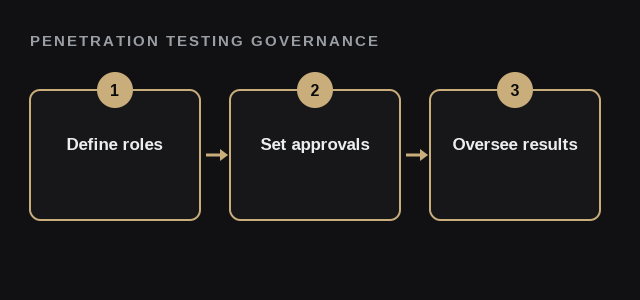
Penetration testing governance is the set of roles and rules that decide how testing is approved, authorized and overseen. It keeps testing lawful, consistent and visible to the people accountable for risk.
- Principal-led mandates
- Fixed fee agreed in writing
- Nothing retained afterwards
Why penetration testing governance matters
Testing touches live systems and sensitive data. So someone must decide what is tested, someone must authorize it, and someone must check that findings are handled.
Without clear roles, each test is negotiated from scratch. In addition, risk decisions are made by whoever happens to be in the room.
The roles in penetration testing governance
Most organizations need five roles. One person may hold more than one, but each must be named.
Then write the roles into the program document. As a result, a new manager can see who decides what.
| Role | Decision |
|---|---|
| Executive sponsor | Approves the program and budget |
| Program owner | Plans and commissions tests |
| System owner | Signs authorization for each system |
| Risk approver | Accepts findings that will not be fixed |
| Oversight body | Reviews results and trends |
Governance review list
Tick each role or rule your organization has in writing.
Your result appears here as you tick, so you can see what is still open.
Authorization as a governance control
Testing is lawful only with written permission from the system owner. Unauthorized access is a criminal offence in both the United States and the United Kingdom.
Therefore treat the signature as a control, not a formality. For example, check that the signatory actually owns the systems listed.
Risk acceptance in penetration testing governance
Some findings will not be fixed quickly. When that happens, a named approver should accept the risk in writing, with a review date.
Because the decision is recorded, it can be revisited. So accepted risks do not quietly become permanent.
Oversight and reporting
An oversight body, such as a risk committee, should see a short summary after each cycle. It needs tests completed, findings open and risks accepted.
Also give it the trend across cycles. That is how penetration testing governance shows whether the program is working.
How our mandates support governance
Every mandate starts with written permission from the system owner, a defined scope and mutual non-disclosure, signed before any technical discussion. A senior professional hacker leads the work and writes the debrief.
Full mandates run from $35,000 to $120,000, while the floor is $25,000. Also, the bounded Exposure Assessment starts at $4,500. Moreover, its fee is credited in full against a full engagement commissioned within ninety days. One fixed fee is agreed after the written scoping brief, and it is invoiced against milestones.
Penetration testing governance questions
Who should sit at the top of penetration testing governance?
An executive sponsor who approves the program and budget.
Is authorization part of penetration testing governance?
Yes. The system owner's signature is the core control.
Who accepts risk in penetration testing governance?
A named approver, in writing, with a review date.
How often should oversight meet?
After each testing cycle, and at least once a year.
Related guides
Request an introduction
Describe how testing is approved in your organization today. A senior professional hacker replies within one business day when the mandate is a fit.
Request an introduction