Briefing
Building a penetration testing budget that matches the scope
A penetration testing budget is the yearly figure set aside for testing, and the plan for how it is split. It works best when it starts from scope rather than from last year's number.
- Principal-led mandates
- Fixed fee agreed in writing
- Nothing retained afterwards
Why the penetration testing budget starts from scope
A figure carried over from last year says little about this year's estate. For example, a new product or a cloud move changes what needs testing.
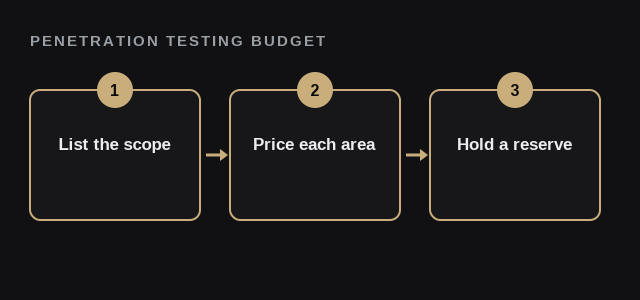
So list the systems first. Then price each area, and the total follows from the work rather than from habit.
How a penetration testing budget is usually split
Most budgets have three parts: the planned tests, a reserve and the time your own teams spend on fixes. The last part is often forgotten.
Also plan the timing of spend. Because tests are spread across the year, invoices are too.
| Part | What it covers |
|---|---|
| Planned tests | Areas in the yearly calendar |
| Reserve | Launches, acquisitions or urgent requests |
| Internal time | Engineers preparing and fixing |
| Retests | Usually included; check each contract |
Budget planning list
Tick each item your plan already covers.
Your result appears here as you tick, so you can see what is still open.
When the budget and the scope disagree
Sometimes the figure will not carry the scope. In that case, change the scope rather than the standard of the work.
For example, test the most important systems fully and move the rest to the next cycle. That choice is easier to defend than a thin test of everything.
Presenting the penetration testing budget
Leadership usually asks three questions. What will we test, what will we learn, and what happens if we do not?
Therefore present the budget as a list of decisions, not a line item. As a result, approvers can see what each cut would remove.
Fixed fees and predictability
Fixed fees make planning easier, because the number is known before the work starts. In addition, there is no reason for anyone to stretch the hours.
So ask each provider for one number per scope. Then the penetration testing budget can be built line by line.
Our fees, stated plainly
Full mandates run from $35,000 to $120,000, while the floor is $25,000. Also, the bounded Exposure Assessment starts at $4,500. Moreover, its fee is credited in full against a full engagement commissioned within ninety days. One fixed fee is agreed after the written scoping brief, and it is invoiced against milestones.
Where a budget will not carry a scope, we change the scope rather than the standard. The bounded Exposure Assessment exists for exactly that situation.
Penetration testing budget questions
How is a penetration testing budget set?
From the list of systems in scope, priced area by area.
Should a penetration testing budget include a reserve?
Yes. Launches and acquisitions often need tests nobody planned.
What if the penetration testing budget is too small?
Narrow the scope and keep the depth. Then move the rest to the next cycle.
Are retests part of the budget?
Check each contract. Ours are included.
Related guides
Request an introduction
Tell us the scope and the figure you have in mind. A senior professional hacker replies within one business day when the mandate is a fit.
Request an introduction